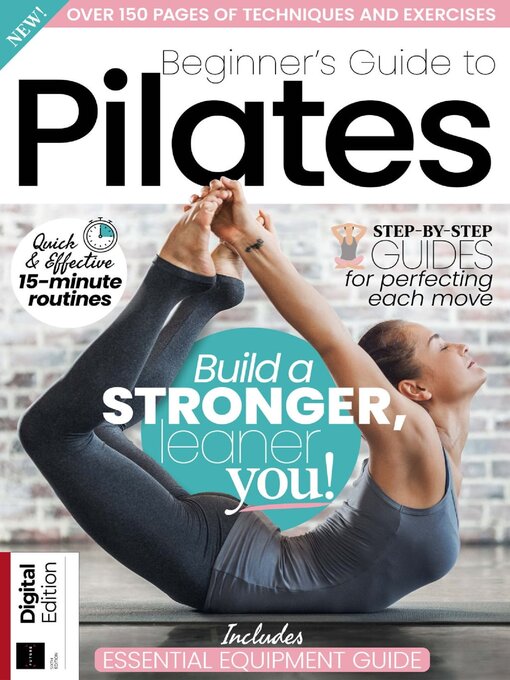
Want to learn Pilates but don't know where to start? Take the first step with Beginner's Guide to Pilates, where nothing is assumed and everything is explained. Learn at your own pace, in your own time and in the comfort of your own home. Each course follows the same structure: start simple and learn the basics, build on what you've learnt and then show off your new skills! This book will take you from complete beginner to being able to master Pilates poses and movement sequences. Start simple with basic Pilates exercises including leg and spine stretches, build on them with the mini bridge and side kicks, and take it further with climb like a tree and the swan. The step-by-step pictures show you what other courses only tell you and the practice moves keep you on the right track. Beginner's Guide to Pilates will help you learn your new skill in no time.
Welcome
Build Your Course
The 6 Principles of Pilates OF PILATES
The 6 Key Benefits of Pilates • Pilates combines strengthening with relaxation; it lightens the load on your spine and joints by correcting muscular imbalances due to bad posture or misuse of muscles and alleviate tension. You’ll rediscover your body’s natural movement patterns and notice these benefits…
The Science of Alignment • Pilates trains you to use the deep core muscles of the powerhouse - the abdominals, back, and pelvic floor - to support your posture and bring your skeleton into alignment, so you can move correctly and efficiently.
The Science of Breathing • Joe Pilates said, “Above all, learn to breathe correctly.” Deep breathing coordinated with movement forms the foundation of all of his exercises. Carry this breathing skill into your daily life and you’ll feel energized and calmed, your blood pressure will reduce, and your circulation will improve.
Essential Equipment
1 Start Simple • Now that you understand the fundamental principles behind Pilates, you are ready to start putting theory into practice. In this first section, you will be guided through some key techniques and exercises, so that you can create a solid foundation of skills and movements and start developing an awareness of your body’s weaknesses and strengths. By the end of this chapter, you will be able to put together what you’ve learned into an exercise sequence.
Plan Your Programme • Joe Pilates said “In 10 sessions you will feel the difference, in 20 you will see the difference, and in 30 you will have a whole new body.” Congratulations on committing to Pilates – if you put in the effort, you will soon begin to feel the benefits.
Key Techniques to Practise • In Pilates there are a few fundamental positions you need to master to ensure your workout is safe and effective. Practise these positions until you feel them confidently and correctly in your body, and revisit them regularly as you advance through the levels.
Warm-up • Before each Pilates workout you must warm up your body. Take a few minutes to practise one, or all, of these exercises to mobilize the spine, focus on your breathing, and relax your muscles in preparation for movement. The seated C-curve (p.30) and Pilates stance (see opposite) are positions that you need to create in many exercises shown in this book. Learn to engage your powerhouse (p.31) correctly to move with energy, stability, strength, and control. Remember to practise your key techniques as you perform these exercises.
Centring • This is a great way to strengthen your core (the muscles that protect your lower back, abdominals, and pelvic floor). Revisit it regularly to reinforce the feeling in your body and strengthen the connection to your powerhouse (p.31).
Neck Peels • This tones the abdominal muscles, while keeping the neck free from strain. Allow the weight of your head to be carried entirely by your arms...